Monday, May 31, 2010

NATO Has High Hopes for Afghan Peace Council


  By ALISSA J. RUBIN

  Published: May 30, 2010

  Sign in to Recommend

  Twitter

  Sign In to E-Mail

  Print

  Reprints

  ShareClose

  Linkedin

  Digg

  Facebook

  Mixx

  MySpace

  Yahoo! Buzz

  Permalink

  KABUL, Afghanistan — Western leaders are banking on a national peace council set to begin here on Wednesday to start a new chapter in Afghanistan’s political life, bringing the country together and strengthening President Hamid Karzai, even as security deteriorated on Sunday in several areas of the country.

  Enlarge This Image


  Ahmad Masood/Reuters


At War

  Notes from Afghanistan, Pakistan, Iraq and other areas of conflict in the post-9/11 era.

  Go to the Blog »

  Related

  Times Topics: Afghanistan | North Atlantic Treaty Organization

  In a joint news conference, the NATO commander, Gen. Stanley A. McChrystal, and the senior civilian representative, Mark Sedwill, emphasized that the West supported the peace council, called a jirga, even as many Afghans questioned whether those attending would truly represent the many factions in the country.

  “This is a big week for Afghanistan,” said Mr. Sedwill, who described the conference as “the first of a series of major political events that are going to set the agenda of 2010.”

  The jirga will be followed by the Kabul Conference on economic development in July and parliamentary elections in September.

  “This is a critical moment for this country to bring together all of the people of Afghanistan, their representatives, in an opportunity to set the direction forward and create a national consensus behind the overall approach to security, to development, to reconciliation,” Mr. Sedwill said.

  The Electoral Complaints Commission announced Sunday that 85 candidates had been preliminarily barred from participating in the parliamentary elections because they are members of illegal armed groups. They will have the right to appeal. Still, the number is far more than that in the first round of parliamentary elections in 2005, when just 17 people were disqualified for the same reason, according to a former E.C.C. commissioner, Fahim Hakim.

  The increase suggests that a more rigorous review system is now in place, analysts say.

  Even as the peace efforts proceed in the capital, Kabul, security appeared to be deteriorating in districts in the east and south of the country and on the western border, where Afghan insurgents trained in Iran are returning to fight and smuggling in weapons, General McChrystal said.

  “There is clear evidence of Iranian activities, in some cases supplying weaponry and training to the Taliban that is inappropriate,” he said.

  In Nuristan Province, on the country’s eastern border, hundreds of local and Pakistani Taliban have taken control of a remote district near the Pakistan border, Barg-e-Matal. The number of fighters who have crossed the border from Pakistan swelled through the week and now has reached 1,000 to 1,500, said Gen. Zaman Mamozai, the commander of the Afghan Border Police for the eastern region of Afghanistan.

  They are “mostly from Pakistan and are conducting collective attacks,” he said.

  It appears that many of the Taliban from Pakistan had come to Nuristan in search of a new haven after having come under attack from the Pakistani Army in Pakistan. There are few Afghan security troops in Nuristan’s rugged mountains and only a small number of American troops in the province.

  NATO leaders say that they cannot control the entire country with the number of troops they have and had to rely on Afghan forces in remote areas. But because not enough Afghans have been trained, NATO officials say they may have to live with some insurgent havens.

  “As we execute our strategy and our capacity to secure areas, we must prioritize the order in which we do those, and how we deploy our forces and our assets,” General McChrystal said when asked whether Barg-e-Matal was being allowed to become a sanctuary.

  “The Taliban can still muster strength in places and there are a lot of unknowns there,” added a senior NATO officer, speaking about Nuristan on the condition of anonymity because he was not authorized to speak on the record on the matter.

  “If there are Taliban there, so what?” he said, adding that the district was far from any population center. He acknowledged that the situation would become more complicated if the Taliban filter out of remote mountain redoubts and into populated areas.

  There was violence as well in the southeastern province of Khost, where a barely completed high school, built with international aid, was blown up late Saturday night by men using rocket-propelled grenades and bombs.

  The school, which cost $220,000 to build, would have provided classrooms for 1,300 students, said Musa Majrooh, the spokesman for the Khost Education Department. A Taliban spokesman, Zabiullah Mujahid, denied that the Taliban were involved in the blast.

  Also in Khost, a suicide car bomber detonated his vehicle at the entrance to the police battalion that patrols suburban areas. Nine police officers were wounded, two of them seriously.

  In Nangahar Province, in the east, which until recently was relatively calm, two bombings killed five members of the Afghan security forces, and in Badakhshan Province in the far northeast, six counternarcotics officers were killed when their patrol vehicle was blown up by a homemade bomb.

  They were on a mission to eradicate poppy, and the province’s governor, Baz Mohammed, accused narcotics traffickers and the Taliban of setting the bomb.

  Sharifullah Sahak and Waheed Abdul Wafa contributed reporting from Kabul, and an Afghan employee of The New York Times from Khost.

Fisherman files restraining order against BP


t1larg.jpg

  New Orleans, Louisiana (CNN) -- A fisherman who was hospitalized after becoming ill while cleaning up oil in the Gulf of Mexico has filed a temporary restraining order in federal court against oil company BP.

  John Wutsell Jr., is asking BP to give the workers masks and not harass workers who publicly voice their health concerns.

  Wutstell, a shrimper, said he was paid by BP to use his boat, Ramie's Wish, to clean up oil that has been gushing into the Gulf since an oil rig sank about 40 miles off the Louisiana coast, gushing an estimated 19,000 barrels (798, 000 gallons) of crude a day.

  In an affidavit, Wustell wrote he started experiencing severe headaches and nasal irritation on May 24. Over the next few days, he also developed nosebleeds, an upset stomach, and aches.

  On Friday, Wutstell was airlifted to West Jefferson Medical Center in Marrero, Louisiana, where he remained hospitalized Sunday.

  Eight other workers were brought to the hospital this week and were all released.

  "We need to start protecting these guys," said Jim Klick, Wutstell's lawyer.

  In his affadavit, Wutstell described his experience at the hospital.

  "At West Jefferson, there were tents set up outside the hospital, where I was stripped of my clothing, washed with water and several showers, before I was allowed into the hospital," Wutstell sais. "When I asked for my clothing, I was told that BP had confiscated all of my clothing and it would not be returned."

  The restraining order requests that BP refrain from "altering, testing or destroying clothing or any other evidence or potential evidence" when workers become ill.

  Graham MacEwen, a spokesman for BP, said he could not comment on the restraining order, or on allegations that BP confiscated clothing.


  Video: BP protesters swarm New Orleans


  Video: Oil spill cleanup for show?


  Video: BP CEO: 'Relief well ultimate solution'

  He denied accusations from Clint Guidry, president of the Louisiana Shrimpers Association, that BP has been threatening workers who speak out about health concerns.

  Fishermen contacted by CNN have declined to speak publicly.

  Some, who are making as much as $3,000 a day cleaning up the oil, have said they fear losing their jobs with BP.

  "The BP oil spill wiped out their professions and their jobs this year and possibly years down the road," Klick said. "The only work they can get right now is with BP."

  The BP spokesman said there have been no threats against workers for speaking out.

  "If they have any concerns, they should raise them with their supervisors," MacEwen said. "They can also call the joint information center and make complaints anonymously."

  Wutstell is one of nine clean-up workers who were sent to the hospital with symptoms such as shortness of breath, nose and throat irritation, headaches, and dizziness.

  The restraining order requests that BP stop using dispersants without providing "appropriate personal protective equipment" to workers.

  Corexit, a dispersant, is being sprayed into the Gulf to break down the oil. The safety data information sheet from the manufacturer states that people should "avoid breathing in vapor" from Corexit, and that masks should be work when Corexit is present in certain concentrations in the air.

  BP has not supplied workers with masks when they work near the oil and dispersants.

  "We're been carrying out very extensive air quality since early on in this exercise, to make sure that we have working safe conditions, and thus far not found situations where there are air quality concerns that would require face masks," MacEwen said.

  He added that workers who want to wear masks are "free to do so" as long as they receive instructions from their supervisors on how to use them.

  According to Guidry from the shrimpers' association, BP told workers they were not allowed to wear masks.

  "Some of our men asked, and they were told they'd be fired if they wore masks," he said.

  Tony Hayward, the chief executive officer of BP, offered another explanation for the fishermen's illness: spoiled food.

  "Food poisoning is clearly a big issue," Hayward said Sunday. "It's something we've got to be very mindful of. It's one of the big issues of keeping the Army operating. You know, the Army marches on their stomachs."

  An expert on foodborne illness cast doubt on Hayward's theory.

  "Headaches, shortness of breath, nosebleeds -- there's nothing there that suggests foodborne illness," said Dr. Michael Osterholm, a professor at the University of Minnesota School of Public Health. "I don't know what these people have, but it sounds more like a respiratory illness."


World Cup 2010: FA to meet Fabio Capello over contract


  Advertisement

  Fabio 'focused only on World Cup'

  Fabio Capello will meet the Football Association on Monday for talks that are expected to lead to him committing his future to England as manager.

  The Italian has been heavily linked with a summer move to Inter Milan.

  And though his England deal runs until 2012, it contains a clause that allows Capello to quit after the World Cup.

  But having made a verbal agreement with ex-Football Association chairman Lord Triesman to stay on beyond Euro 2012, Capello is keen to end speculation.

  He will speak to Sir David Richards, chairman of the newly formed Club England board, and a resolution should be known at some point in the next 48 hours.

  "I always say the same things," said Capello in response to questions about his future following England's 2-1 friendly win over Japan in Graz.

  "My name is always in the newspapers. My name has been on the radio but I can't say anything about it. I have not spoken with anyone from Inter Milan.

  "I spoke with the first chairman [Lord Triesman]. Now I wait to speak to the other one. I need to speak with the new chairman of Club England, Sir David Richards."


  Triesman was forced to resign earlier this month after what he referred to as his "entrapment" by the Mail on Sunday newspaper.

  But just prior to Lord Triesman's departure, Capello was widely believed to be ready to rip up a clause in his current deal that allows either the Italian or the Football Association to end the contract early this summer.

  Triesman's departure therefore threw Capello's position into confusion and opened the door to reports that the 63-year-old could head to Inter after the World Cup as a replacement for Real Madrid-bound Jose Mourinho.

  However, with the appointment of Richards, plus that of communications chief Adrian Bevington, who has been confirmed as Club England's new managing director with immediate effect, some clarity has been brought to the situation.

  Capello now hopes his own future can be confirmed before his team depart for their World Cup adventure on Wednesday evening.

  "The situation will be clear in two days when I will have spoken with Sir David Richards," added Capello. "I shook the hand of Lord Triesman but I have not written anything."

  In any conversation about his contract, Capello always qualifies it with the claim that should England fail to match expectations in the finals in South Africa, which start on 11 June, he could easily find himself surplus to requirements.

  Such is the improvement that has been made since he succeeded Steve McClaren in December 2007, though, such a scenario is unlikely to unfold.

  And Bevington has confirmed that is the FA's position.

  "We will be speaking with Fabio tomorrow [Monday] morning and going over the previous conversations that his advisers had with Lord Triesman about us wanting Fabio to stay until after Euro 2012," stated Bevington.

  "That is still our position. We have not changed on that whatsoever."

Sunday, May 30, 2010

How Computers Know What We Want — Before We Do


  Here's an experiment: try thinking of a song not as a song but as a collection of distinct musical attributes. Maybe the song has political lyrics. That would be an attribute. Maybe it has a police siren in it, or a prominent banjo part, or paired vocal harmony, or punk roots. Any one of those would be an attribute. A song can have as many as 400 attributes — those are just a few of the ones filed under p.

  This curious idea originated with Tim Westergren, one of the founders of an Internet radio service based in Oakland, Calif., called Pandora. Every time a new song comes out, someone on Pandora's staff — a specially trained musician or musicologist — goes through a list of possible attributes and assigns the song a numerical rating for each one. Analyzing a song takes about 20 minutes.

  The people at Pandora — no relation to the alien planet — analyze 10,000 songs a month. They've been doing it for 10 years now, and so far they've amassed a database containing detailed profiles of 740,000 different songs. Westergren calls this database the Music Genome Project. (See the world's most influential people in the 2010 TIME 100.)

  There is a point to all this, apart from settling bar bets about which song has the most prominent banjo part ever. The purpose of the Music Genome Project is to make predictions about what kind of music you're going to like next. Pandora uses the Music Genome Project to power what's known in the business as a recommendation engine: one of those pieces of software that gives you advice about what you might enjoy listening to or watching or reading next, based on what you just listened to or watched or read. Tell Pandora you like Spoon and it'll play you Modest Mouse. Tell it you like Cajun accordion virtuoso Alphonse "Bois Sec" Ardoin and it'll try you out on some Iry LeJeune. Enough people like telling Pandora what they like that the service adds 2.5 million new users a month. (See the 100 best albums of all time.)

  Over the past decade, recommendation engines have become quietly ubiquitous. At the appropriate moment — generally when you're about to consummate a retail purchase — they appear at your shoulder, whispering suggestively in your ear. Amazon was the pioneer of automated recommendations, but Netflix, Apple, YouTube and TiVo have them too. In the music space alone, Pandora has dozens of competitors. A good recommendation engine is worth a lot of money. According to a report by industry analyst Forrester, one-third of customers who notice recommendations on an e-commerce site wind up buying something based on them. (Watch TIME's video "The Brains Behind Pandora Radio.")

  The trouble with recommendation engines is that they're really hard to build. They look simple on the outside — if you liked X, you'll love Y! — but they're actually doing something fiendishly complex. They're processing astounding quantities of data and doing so with seriously high-level math. That's because they're attempting to second-guess a mysterious, perverse and profoundly human form of behavior: the personal response to a work of art. They're trying to reverse-engineer the soul.

  They're also changing the way our culture works. We used to learn about new works of art from friends and critics and video-store clerks — from people, in other words. Now we learn about them from software. There's a new class of tastemakers, and they're not human.

  Learning to Love Dolph Lundgren

  Pandora makes recommendations the same way people do, more or less: by knowing something about the music it's recommending and something about your musical taste. But that's actually pretty unusual. It's a very labor-intensive approach. Most recommendation engines work backward instead, using information that comes not from the art but from its audience. (See the 50 best websites of 2009.)

  It's a technique called collaborative filtering, and it works on the principle that the behavior of a lot of people can be used to make educated guesses about the behavior of a single individual. Here's the idea: if, statistically speaking, most people who liked the first Sex and the City movie also like Mamma Mia!, then if we know that a particular individual liked Sex and the City, we can make an educated guess that that individual will also like Mamma Mia!

  It sounds simple enough, but the closer you look, the weirder and more complicated it gets. Take Netflix's recommendation engine, which it has dubbed Cinematch. The algorithmic guts of a recommendation engine are usually a fiercely guarded trade secret, but in 2006 Netflix decided it wasn't completely happy with Cinematch, and it took an unusual approach to solving the problem. The company made public a portion of its database of movie ratings — around 100 million of them — and offered a prize of $1 million to anybody who could improve its engine by 10%.

  The Netflix competition opened a window onto a world that's usually locked away deep in the bowels of corporate R&D departments. The eventual winner — which clinched the prize last fall — was a seven-man, four-country consortium called BellKor's Pragmatic Chaos, which included Bob Bell and Chris Volinsky, two members of AT&T's research division. Talking to them, you start to see how difficult it is to make a piece of software understand the vagaries of human taste. You also see how, oddly, software understands things about our taste in movies that a human video clerk never could.

  The key point to grasp about collaborative-filtering software is that it knows absolutely nothing about movies. It has no preconceptions; it works entirely on the basis of the audience's reaction. So if a large enough group of people claim to have enjoyed, say, both Saw V and On Golden Pond, the software would be forced to infer that those two movies share some common quality that the viewers enjoyed. Crazy? Or crazy genius? (See the 100 best movies of all time.)

  In such a case, the software would have discovered an aesthetic property that we might not even be aware of or have a name for but which in a mathematical sense must be said to exist. Even Bell and Volinsky don't always know what the properties are. "We might be able to describe them, or we might not be able to," Bell says. "They might be subtleties like 'action movies that don't have a lot of blood, don't have a lot of profanity but have a strong female lead.' Things like that, which you would never think to categorize on your own." As Volinsky puts it, "A lot of times, we don't come up with explanations that are explainable."

  That makes recommendation engines sound practically psychic, but everyday experience tells us that they're actually pretty fallible. Everybody has felt the outrage that comes when a recommendation engine accuses one of a secret desire to watch Rocky IV, the one with Dolph Lundgren in it. In 2006, Walmart was charged with racism when its recommendation engine paired Planet of the Apes with a documentary about Martin Luther King. But generally speaking, the weak link in a recommendation engine isn't the software; it's us. Collaborative filtering works only as well as the data it has available, and humans produce noisy, low-quality data.

  The problem is consistency: we're just not good at expressing our desires in rating form. We rate things differently after a bad day at work than we would if we were on vacation. Some people are naturally stingy with their stars; others are generous. We rate movies differently depending on whether we rate them right after watching them or if we wait a week, and differently again depending on whether we saw a lousy movie or a good movie in that intervening week. We even rate differently depending on whether we rate a whole batch of movies together or one at a time. (See the 50 best inventions of 2009.)

  All this means that there's a ceiling to how accurate collaborative filtering can get. "There's a lot of randomness involved," Volinsky admits. "There's some intrinsic level of error associated with trying to predict human behavior."

  The Great Choice Epidemic

  Recommendation engines are a response to the strange new world of online retail. It's a world characterized by a surplus of something we usually can't get enough of: choice.

  We're drowning in it. As Sheena Iyengar points out in her book The Art of Choosing, in 1994 there were 500,000 different consumer goods for sale in the U.S. Now Amazon alone offers 24 million. When faced with such an oversupply of choice, our little lizard brains go straight to vapor lock. "We think the profusion of possibilities must make it that much easier to find that perfect gift for a friend's birthday," Iyengar writes, "only to find ourselves paralyzed in the face of row upon row of potential presents." We're living through an epidemic of choice. We require an informational prosthesis to navigate it. The recommendation engine is that prosthesis: it winnows the millions of options down to a manageable handful.

  But there's a trade-off involved. Recommendation engines introduce a new voice into the cultural conversation, one that speaks to us when we're at our most vulnerable, which is to say at the point of purchase. What is that voice saying? Recommendation engines aren't designed to give us what we want. They're designed to give us what they think we want, based on what we and other people like us have wanted in the past.

  Which means they don't surprise us. They don't take us out of our comfort zone. A recommendation engine isn't the spouse who drags you to an art film you wouldn't have been caught dead at but then unexpectedly love. It won't force you to read the 18th century canon. It's no substitute for stumbling onto a great CD just because it has cool cover art. Recommendation engines are the enemy of serendipity and Great Books and the avant-garde. A 19th century recommendation engine would never have said, If you liked Monet, you'll love Van Gogh! Impressionism would have lasted forever.

  The risk you run with recommendation engines is that they'll keep you in a rut. They do that because ruts are comfy places — though often they're deeper than they look. "By definition, we keep you in the same musical neighborhood you start in," says Westergren of the Music Genome Project, "so you could say that's limiting. But even within a neighborhood, there is a ton of room for discovery. Forty-five percent of the people who use Pandora buy more music after they start, and only 1% buy less." And not being based solely on data from its audience, Pandora isn't as vulnerable to peer pressure as most recommendation engines are. It doesn't follow the crowd.

  Pandora is unusual, though. The general effect of recommendation engines on shopping behavior is a hot topic among econometricians, if that's not an oxymoron, but the consensus is this: they introduce us to new things, which is good, but those new things tend to be a lot like the old things, and they tend to be drawn from the shallow pool of things other people have already liked. As a result, they create a blockbuster culture in which the same few runaway hits get recommended over and over again. It's the backlash against the "long tail," the idea that shopping online is all about near infinite selection and cultural diversity. It has a bad habit of eating its own tail and leaving you back where you started. (See the latest geek culture stories at Techland.com.)

  But this isn't just about retail. The Web has transformed how we shop. Now it's transforming our social lives too, and recommendation engines are coming along for the ride. Just as Netflix reverse-engineers our response to art, dating sites like Match.com and eHarmony and OKCupid use algorithms to make predictions about that equally ineffable human phenomenon, love; or, failing that, lust. The idea is the same: they break down human behavior into data, then look for patterns in the data that they can use to pair up the humans.

  Even if you're not into online dating, you're probably on Facebook, currently the second most visited site on the Web. Facebook gives users the option of switching between a straight feed, which shows all their friends' news in chronological order, and an algorithmically curated selection of the updates Facebook's recommendation engine thinks they'd most like to see. And in the right-hand column, Facebook uses a different set of algorithms to recommend new friends. If you loved Jason, why not try Jordan?! (See pictures of Facebook headquarters.)

  And as for the first most trafficked site on the Web, if you cock your head only slightly to one side, Google is, effectively, a massive recommendation engine, advising us on what we should read and watch and ultimately know. It used to return the same generic results to everyone, but in December it put a service called Personalized Search into wide release. Personalized Search studies the previous 180 days of your searching behavior and skews its results accordingly, based on its best guess as to what you're looking for and how you look for it.

  The principle is almost endlessly generalizable. Anywhere the specter of unconstrained choice confronts us, we're meeting it by outsourcing elements of the selection process to software. Largely unconsciously, we radiate information about ourselves and our personal preferences all day long, and more and more recommendation engines of all shapes and sizes are hoovering up that data and feeding it back to us, reshaping our reality into a form that they fondly hope will be more to our liking — in an endless feedback loop. The effect is to create a customized world for each of us, one that is ever so slightly childproofed, the sharp edges sanded off, and ever so slightly stifling, like recirculated air. (See 25 websites you can't live without.)

  How far will it go? Will we eventually surf a Web that displays only blogs that conform to our political leanings? A social network in which we see only people of our race and religion? Our horizons, cultural and social, would narrow to a cozy, contented, claustrophobic little dot of total personalization.

  Let's hope not. People weren't built to play it safe all the time. We were meant to be bored and disappointed and offended once in a while. It's good for us. That's what forces us to evolve. Even if it means watching Rocky IV, with Dolph Lundgren. Who knows? You might even like it.


Sophie Howard - Bedridden

  Sophie Howard - Bedridden


Sophie Howard

  Back to browse more 100 Sexiest Women

  I love my bed – both for sleeping and having sex.

  A few things to know about Miss Howard: 1. She's been in the Salvation army in her time. 2. She once worked as a stripper. 3. She has ten tattoos – the biggest being the three stars on her back, and these are often removed using the magic of photoshop before she hits your magazine rack. 4. She is a 34G. Honestly. 5. She's from Southport and supports Liverpool. 6. She was once a marketing student. So there. Aside from that, she's stunning. Which is the most important thing, frankly.


Pop up denim bar from My ourshoesbox.com


Pop up denim bar from My wardrobe.com

  Expert denim advice available for all comers on Carnaby Street

  What is it?

  Designer retail website mywardrobe.com have dipped their toes into the world of actual shopping with the launch of their denim bar on London's Carnaby Street.

  What's good about it?

  Mywardrobe.com have an excellent selection of denim brands including Nudie, PRPS, Acne, Stone Island and Levis but shopping on line for denim can be tricky. The pop up denim bar then is the perfect opportunity to come down and actually try things on. You'll also find the guys who buy the denim in for Mywardrobe.com on hand to give advice on brands, fits and styles. Trust us when we say that denim buyers know their stuff, so it's worth picking their brains.

  What's bad about it?

  When we say it's the ideal opportunity to actually try jeans on, we realise that this only applies if you live in and around the M25. Otherwise it's a bit of a trek. Hopefully Mywardrobe will roll the denim bar concept out nationwide.

  Gimme:

  Launching tonight and open for two days (Thursday the 27th and Friday the 28th) The denim bar is at number 38 Carnaby street, London W1F 7DS. Alternatively check out www.ourshoesbox.com now where the site is themed around the denim bar concept.


Cox: Cup final remains unsolved mystery

  Cox: Cup final remains unsolved mystery


Chicago's Jonathan Toews and goalie Antti Niemi celebrate Game 1 victory.

  Chicago's Jonathan Toews and goalie Antti Niemi celebrate Game 1 victory.

  JOHN GRESS/REUTERS

  CHICAGO

  Every series has to start someplace, and where it starts doesn’t necessarily describe where it’s headed.

  So don’t read too much into Game 1 of the Stanley Cup final, an altogether wacky result.

  It was fun — a “ping pong” game, according to Chicago captain Jonathan Toews. Lots of people watched in the U.S. and in Canada. There were lots of goals, lots of errors, not many saves and multiple lead changes until the Blackhawks prevailed 6-5 to take a 1-0 series advantage.

  Game 1 mostly provided compelling evidence that pretty much every pre-series story that attempted to suggest the way in which this Flyers-Hawks final would be contested was off base.

  Didn’t hear anybody writing or broadcasting that Tomas Kopecky and Troy Brouwer were the Chicago shooters worth watching, or that Toews would need to do a good job checking Daniel Briere or the Philly offence might run wild.

  And what about all that chatter about how the very affordable goalies playing for both teams — not including Cristobal Huet, officially on Joel Quenneville’s persona non grata list — was evidence of a new reality in the NHL and how high-profile, high-salaried goalies were no longer necessary to win a Cup?

  When it comes to this series, rather than anticipating what is going to happen, we may just have to watch it happen and then try to explain it. There’s a lot of youth on both sides, many players thrust into this sporting petri dish for the first time, and their reactions might not be consistent with how they perform in ordinary circumstances.

  “You try to treat it as a normal game,” said Toews, “but it’s tough not to get excited about it. Both teams maybe realized that too much (in Game 1).

  “You score six goals, you better be winning hockey games. You sure don’t want to be in a situation where you’re scoring six goals and just winning by one.”

  Toews went into the series opener as a leading candidate for the Conn Smythe Trophy, then delivered one of his worst games of the playoffs: no points, minus-3. He and linemate Patrick Kane didn’t display that mutual understanding they’d shown earlier in the post-season, possibly because they were spending so much time checking — or not checking — Briere and his linemates, Scott Hartnell and Ville Leino.

  “I haven’t had a game like that in a long time,” said Toews, who was an excellent 18-6 on faceoffs. “I’m very thankful that as a team we found a way to win.”

  So much is expected of the 22-year-old Toews, the NHL’s leading scorer in these playoffs, and his sidekick Kane, 21, that it may take them a while to get the feel of playing in a Cup final.

  “This is the big show,” said Toews. “You want to play your best hockey every shift.”

  Two other Hawk centres, Patrick Sharp and David Bolland, didn’t seem to have the same difficulties on opening night. Sharp scored a pretty goal and was plus 2, Bolland got the assignment, on three-quarters of his shifts, of playing against Flyers captain Mike Richards and ended up with a goal, an assist on Kopecky’s winner and a plus 3.

  Bolland tried, without success, to begin the process of getting under the skin of Richards right at the opening faceoff.

  “I tried staring at him,” smiled Bolland. “He didn’t say much, though.”

  Sharp smiled when he heard Toews was beating himself up over his Game 1 performance.

  “I’m sure he’ll be watching the game over and over again,” said Sharp. “He’s 22 years old and it seems like he’s 32 years old, the way he carries himself. I know he wants to be a big part of this team the way he has been all year long.

  “I thought the week off, talking about every story in the series, weighed on the teams a little bit.”

  There’s an expectation that Game 2 will be more buttoned-down for both clubs, and maybe that will be true. Flyer coach Peter Laviolette said earlier in the playoffs that momentum doesn’t usually decide games but rather desperation, or the team most in need of a victory.

  That will be Philly Monday night, although we’re far away from a must-win situation even though history says a 2-0 series lead in a Stanley Cup final is all but insurmountable.

  What happens in the second game, it’s fair to say, is much more likely to foreshadow what will occur the rest of the way.


So You Think You Can Dance Canada alumna turns to disco


  Romina D’Ugo stars in the CTV movie Turn the Beat Around


Romina D'Ugo stars in the CTV disco movie Turn the Beat Around.

  Romina D'Ugo stars in the CTV disco movie Turn the Beat Around.

  HANDOUT

  Romina D’Ugo knows a thing or two about following your heart.

  The 24-year-old had to make a tough choice right after high school: study sciences in preparation for a stable career as a chiropractor or pursue her passion for the arts.

  She chose the latter, which explains why you might recognize the Torontonian from the TV or movie screen.

  She’s been in a bunch of productions since she graduated from the Sheridan College musical theatre program almost four years ago: she had a recurring role in Degrassi: The Next Generation (Nina); a role in the recent Syfy miniseries Riverworld; small parts in movies like Hairspray and How She Move; and she made top 20 on Season 1 of So You Think You Can Dance Canada.

  There was a lot to like about her latest role, as lead character Zoe Benjamin in the CTV move Turn the Beat Around, airing Sunday at 8 p.m. (it repeats next Friday at 7 and 11 p.m. on MuchMusic).

  For one thing, D’Ugo could relate to Zoe’s dilemma in the film.

  “She’s essentially a struggling young dancer in L.A.,” D’Ugo said. “She’s fighting between what her parents want her to do, what everyone in her life wants her to do, vs. what she knows in her heart she’s destined for.”

  And then there’s the fact that D’Ugo got to combine two of her passions: dancing and acting. And not just any dancing: disco.

  Obviously, she’s far too young to have experienced the style in its mid-70s heyday, but when D’Ugo was a teenager — she started dance lessons at 8 —her dance studio did Saturday Night Fever as its recital one year.

  And just before she started shooting Turn the Beat Around, she made another disco-themed movie in Montreal, Funkytown, which is expected to be released in December (she had one day off in between the two, her birthday).

  “For Funkytown we kept it really to the era, whereas in Turn the Beat Around we incorporated funky hip hop and salsa, and we modernized it and contemporized it.”

  She added that she’s now a huge fan of disco: “My iPod is just filled with disco.”

  The person who choreographed all those moves for Turn the Beat Around was a familiar face to D’Ugo: So You Think You Can Dance Canada judge Tre Armstrong.

  Besides the reality TV show, Armstrong and D’Ugo worked together on How She Move, which starred Armstrong, and the movie Honey, which starred Jessica Alba.

  “By the time Turn the Beat Around came to be, Tre and I had a really solid work ethic and we had a solid way of communicating. . . . Working with her is always just a real pleasure.

  “Working with the other dancers from So You Think You Can Dance was great as well.”

  Joining D’Ugo in the cast are SYTYCDC Season 1 finalists Natalli Reznik and Miles Faber, and Top 20 dancers Tamina Pollack-Paris, Caroline Torti and Bre Wong.

  The movie, which was shot over 18 days in Toronto, also features Brooklyn Sudano, the daughter of disco queen Donna Summer, and a performance by pop star Jason Derulo.

  “I think a lot of people can relate to (Zoe’s) struggle to follow her dreams,” said D’Ugo.

  “It’s definitely a feel good movie, you can be sure of that. I’d say it’s an inspirational story as well.”

Topshop tests Toronto market with Ossington Ave. shop


  Trendy British retailer sells selection at ultra-cool boutique Jonathan + Olivia


Collaborations with designers, including one by model Kate Moss in 2007, help rais Topshop's international profile.

  Collaborations with designers, including one by model Kate Moss in 2007, help rais Topshop's international profile.

  TOBY MELVILLE/REUTERS FILE PHOTO

  Topshop, the ultra-trendy British chain store, has finally arrived in Canada.

  But its arrival looks more like a taste test of the Canadian market than a full fledged assault on the retail scene here in Toronto.

  Topshop, which has 300 stores in the UK and 100 internationally, opens its shop-in-a-shop at Jonathan + Olivia on June 19.

  The store at Ossington Ave. and Queen St. W. is growing an extra 800 square feet to house the Topshop collection, which will include the retailer’s well-priced main line and Unique Boutique, its designer collaboration label. Footwear and makeup round out the selection with menswear to follow at a later date.

  “They contacted us about four to five months ago, says Jonathan + Olivia owner Jackie O’Brien-Jones. “They liked what we were doing and it felt like a good fit for both of us.”

  Since opening two years ago, the ultra-cool Jonathan + Olivia has developed a following for its stock of such fashion-insider labels as Alexander Wang, Isabel Marant and Surface To Air.

  But will offering cheap fast fashion in the same store affect the sales of pricier designer merchandise?

  O’Brien-Jones doesn’t think so.

  “That’s the way women shop now, mixing a $20 t-shirt with a designer handbag or shoes,” she says. “It’s a one-stop shop for women.”

  For the past few years, there has been much speculation about when Topshop would open in Canada. Philip Green, the chain’s billionaire owner, told the Star in 2009 that Topshop would launch within nine months.

  Since then, rumors circulated that Topshop would be sold at the Bay.

  Selling a sampling of their collection in Jonathan + Olivia follows a tactic the UK retailer employed before entering the American market.

  Before opening its splashy, multi-leveled store in Manhattan in 2009, Topshop gave New Yorkers a taste of its cheap-and-chic merch by selling a portion of its vast collections in Opening Ceremony — a hipster store in Soho, not unlike Jonathan + Olivia.

The ‘Abortion Caravan’ succeeded. Or did it?


In this 1970 photo, a group of women stands with fists upraised in front of the Parliament buildings in Ottawa after their protest forced the House of Commons to adjourn for a half-hour.

  In this 1970 photo, a group of women stands with fists upraised in front of the Parliament buildings in Ottawa after their protest forced the House of Commons to adjourn for a half-hour.

  Errol Young/Star file photo

  The coat hanger was its graphic symbol of death, outrage and ultimately, a woman’s right to control her own body.

  The “Abortion Caravan” rolled into Ottawa on Mother’s Day weekend in 1970, a convoy of young women — coat hangers and a black coffin in tow — who drew hundreds of supporters during their drive from Vancouver to make an unprecedented demand: unrestricted access to legal abortions.

  “The adrenaline was flowing, we had a cause, we were strong,” says Yvonne Demalpas, who 40 years ago hopped on a bus in Toronto to join the caravaners in Ottawa.

  “We felt we could make a difference.”

  They did, shutting down Parliament for 30 minutes and laying the groundwork to strike abortion completely from the Criminal Code in 1988.

  Now, decades later, those pioneering women fear their hard-fought gains might be jeopardized as the abortion debate reignites at home and abroad.

  “I was appalled,” said Demalpas, referring to Prime Minister Stephen Harper’s refusal to fund aid groups that might help provide abortions in developing countries.

  “So many of us have fought for so long to keep abortion accessible. But I think when people haven’t had to face bad times, perhaps you slowly rest a little bit and you don’t keep fighting.”

  In 1970, the Abortion Caravan planned a daring plot to push the issue from shameful silence into the national consciousness. The Vancouver trekkers held public meetings during stopovers en route to Ottawa, giving women a supportive forum in which to speak publicly for the first time.

  Though it was known the caravan was coming to Ottawa, Canadians were shocked at the protestors’ bold action.

  Hundreds of women rallied for two days at Parliament and some 50 disrupted the sitting House of Commons, chaining themselves to seats and chanting “free abortions on demand.” The Toronto Star reported on May 12, 1970 that one woman hurled a water bomb at the government benches before being rushed by security officers and marched from the building. Others had their chains removed by bolt-cutting guards and were heckled by onlookers as they were escorted from House.

  At 24 Sussex Drive, Prime Minister Pierre Trudeau was burned in effigy. Demalpas was with the group who dumped the coffin at Trudeau’s door. The coffin represented pregnant women who’d died from back-alley procedures or their own horrific attempts with knitting needles or coat hangers.

  The Star reported in 1970 that 2,000 Canadian women died annually from the 100,000 illegal abortions performed each year, and about 20,000 had to be hospitalized with post-abortion complications. As of 1969, limited legal abortions were performed only if a medical panel determined the mother’s health was at risk.

  Jackie Larkin was a budding, 25-year-old Ottawa feminist who slipped her chain around a parliamentary chair leg with her sister protesters. She recalls that the late 1960s and early ’70s were an “opening up about all kinds of ways about thinking about the world.” The rise of feminism, she adds, was a catalyst for Canadian women to wrest control of their reproductive rights from the government.

  “The abortion issue was important because it had been suppressed as an issue,” says Larkin, now a 65-year-old labour and health educator in Victoria. “It was something you didn’t talk about.

  “But there was also the fundamental question of: Do you even have the right to control your own body?”

  The pioneers now fear that decades of pushing for change may be eroded. Hospital cutbacks, hospital closures, little progress in making abortions available in rural areas and the pro-life push on governments by right-wing conservative groups worry Larkin.

  “It pisses me off,” she says, referring to Harper for imposing his “political agenda” on foreign aid.

  “It’s clear in the context of the world in which there’s a rising Christian fundamentalism, (and I think) the Harper government is extremely influenced by that.”

  Demalpas is concerned that women in their 20s and 30s take their freedoms for granted. She wonders if Canadians are aware of the great discrepancies in access to abortion in every province and the difficulties for those in rural areas, where enormous travel times and cost make it prohibitive.

  “So many women’s groups have been shut down by non-funding (by government), I just see a slow reversal back to the bad old days for women,” says the retired union consultant.

  “I’m not sure that young women know how bad it was or what went on or are aware of what they might lose.”

Canada's top soldier in Afghanistan ousted


  Brig.-Gen. Daniel Ménard relieved of mission command over allegations of ‘inappropriate' relationship with female soldier


Brig. Gen. Daniel Menard, commander of Canada's Task Force Afghanistan, stands by a light armoured vehicle in Kandahar Province, southern Afghanistan. (Jan. 30, 2010)

  Brig. Gen. Daniel Menard, commander of Canada's Task Force Afghanistan, stands by a light armoured vehicle in Kandahar Province, southern Afghanistan. (Jan. 30, 2010)

  KIRSTY WIGGLESWORTH/AP FILE PHOTO

  The top Canadian soldier in Afghanistan, Brig.-Gen. Daniel Ménard, has been relieved of duty and ordered home immediately, accused of having an inappropriate personal relationship with a female soldier.

  An investigation has been launched into the conduct of Ménard, who is married. Until next week, the forces in Afghanistan will be commanded by Col. Simon Hetherington, the deputy-commander of Canada's 2,800 soldiers in the country.

  An official in Defence Minister Peter MacKay's office said the allegations against Ménard involve a member of his staff.

  Hetherington told reporters at Kandahar Airfield that Lt.-Gen. Marc Lessard, commander of Canadian military stationed overseas, decided to relieve Ménard of his duties after he lost confidence in his capacity to command.Hetherington declined to comment on specifics of the allegations.

  “As soon as Lt.-Gen. Lessard was made aware of the allegations, which was the 29th of May, he did the proper assessment and made the decision to have him relieved,” Hetherington said.

  Ménard received the news Sunday morning in Afghanistan.

  The military has a strict non-fraternization policy for deployed troops, forbidding personal relationships of an emotional, romantic or sexual nature.

  National Defence spokesperson Lt.-Col. Chris Lemay told the Star by phone from Ottawa Saturday night that the female soldier might also face reprimand after an investigation is complete. “Measures will be taken,” he said.

  The news came only days after Ménard faced a court martial in Canada, where he pleaded guilty to accidentally firing his weapon twice at the Kandahar airbase in March.

  The incident occurred as Ménard walked with Canada's chief of defence staff, Gen. Walter Natynczyk, on his way to a helicopter.

  His fine, imposed by a military judge in Gatineau, Que., was $3,500 — the stiffest fine handed down for mishandling a weapon.

  Brig.-Gen. John Vance will take over the mission.

  While Ménard's sudden removal will have no impact on the service of Canadian troops in Afghanistan, a defence expert said, it could permanently damage Ménard's career.

  “For all intents and purposes, it's a career stopper,” said Stuart Hendin of the University of Ottawa.

  To show there is no double standard in terms of intimate relationships, Ménard would most likely face a “harsher penalty” than a rank-and-file soldier, Hendin noted.

  “There might be a feeling of ‘If the top can act like this, why can't we do it at the bottom?'” he said.

  Hendin stressed that the allegations against Ménard have not been proven.

  Hendin doesn't' believe the dismissal will affect the Afghan mission as a whole.

  “Operations don't rest on one person,” he said.

  “It will probably cause him to be the subject of substantial ridicule within the ranks, but what effect it will have on the actual operating ability of Task Force Afghanistan is probably minimal. They're entering the fighting season, the plan is already in place.”

  Ménard is the second high-ranking Canadian military officer to be relieved of his command in recent months.

  Col. Russell Williams, former commander of CFB Trenton, faces charges in the deaths of two women, the sexual assault of two others and dozens of break-ins.


BP documents show earlier worries for rig's safety


Crews on ships work on skimming and collecting oil near the source site of the Deepwater Horizon disaster May 29, 2010 in the Gulf of Mexico.

  Crews on ships work on skimming and collecting oil near the source site of the Deepwater Horizon disaster May 29, 2010 in the Gulf of Mexico.

  Win McNamee/Getty Images

  WASHINGTON—Internal documents from BP show that there were serious problems and safety concerns with the Deepwater Horizon rig far earlier than those described by the company to Congress last week.

  The problems involved the well casing and the blowout preventer, which are considered critical pieces in the chain of events that led to the disaster on the rig.

  The documents show that in March, after several weeks of problems on the rig, BP was struggling with a loss of “well control.” And as far back as 11 months ago, the company was concerned about the well casing and the blowout preventer.

  On June 22, 2009, for example, BP engineers expressed concerns that the metal well casing that the company wanted to use might collapse under high pressure.

  “This would certainly be a worst-case scenario,” Mark Hafle, a senior drilling engineer at BP, warned in an internal report. “However, I have seen it happen so know it can occur.”

  The company went ahead with the casing, but only after getting special permission from BP colleagues because the casing violated the company's own safety policies and design standards. The internal reports do not explain why the company allowed for an exception to its guidelines.

  Meanwhile, a BP executive said Saturday that a risky procedure to stop the oil spewing into the Gulf of Mexico has yet to show much success, and BP is considering scrapping it in favour of a different method to contain the worst oil spill in U.S. history.

  The comments from chief operating officer Doug Suttles came amid increasing skepticism that the “top kill” operation — which involves pumping heavy drilling mud into the crippled well 1,500 metres underwater — would halt the leak.

  The top kill began Wednesday and “to date it hasn't yet stopped the flow,” Suttles said Saturday at Port Fourchon, La. “What I don't know is whether it ultimately will or not.”

  The oil well blew out on April 20, killing 11 offshore rig workers, and inquiries since then have been looking at the well casing used.

  The BP documents released last week to The New York Times revealed company officials knew the casing was the riskier of two options.

  Though his report indicates the company was aware of certain risks and it made the exception, Hafle, testifying before a panel on Friday in Louisiana about the cause of the rig disaster, rejected the notion the company had taken risks.

  “Nobody believed there was going to be a safety issue,” Hafle told a six-member panel of Coast Guard and Minerals Management Service officials.

  “All the risks had been addressed, all the concerns had been addressed, and we had a model that suggested if executed properly we would have a successful job,” he said.

  BP's concerns about the casing did not go away after Hafle's 2009 report.

  In April of this year, BP engineers concluded the casing was “unlikely to be a successful cement job,” according to a document, referring to how the casing would be sealed to prevent gases from escaping up the well.

  The document also says the plan for casing the well is “unable to fulfill MMS regulations,” referring to the Minerals Management Service.

  A second version of the same document says “it is possible to obtain a successful cement job” and “it is possible to fulfill MMS regulations.”

  Andrew Gowers, a BP spokesman, said the second document was produced after further testing had been done.

  Last Tuesday, Congress released a memorandum with preliminary findings from BP's internal investigation, which indicated that there were warning signs immediately before the explosion on April 20, including equipment readings suggesting that gas was bubbling into the well, a potential sign of an impending blowout.

  A parade of witnesses at hearings last week told about bad decisions and cut corners in the days and hours before the explosion of the rig, but BP's internal documents provide a clearer picture of when company and federal officials saw problems emerging.

  In addition to focusing on the casing, investigators are also focusing on the blowout preventer, a fail-safe device that was supposed to slice through a drill pipe in a last-ditch effort to close off the well when the disaster struck. The blowout preventer did not work, which is one of the reasons oil has continued to spill into the gulf, though the reason it failed remains unclear.

  Federal drilling records and well reports obtained through the Freedom of Information Act and BP's internal documents, including more than 50,000 pages of company e-mail messages, inspection reports, engineering studies and other company records obtained by The Times from congressional investigators, shed new light on the extent and timing of problems with the blowout preventer and the casing long before the explosion.

  Kendra Barkoff, a spokeswoman for the Interior Department, declined to answer questions about the casings, the blowout preventer and regulators' oversight of the rig because those matters are part of a continuing investigation.

  The documents show that in March, after problems on the rig that included drilling mud falling into the formation, sudden gas releases known as “kicks” and a pipe falling into the well, BP officials informed federal regulators that they were struggling with a loss of “well control.”

  On at least three occasions, BP records indicate, the blowout preventer was leaking fluid, which the manufacturer of the device has said limits its ability to operate properly.


Sex abuse victims say church is still tenaciously fighting claims


  Even after convictions, some lawsuits have dragged on for more than a decade; church official blames complexities of judicial system

  John Caruso thought his trauma within the Roman Catholic Church began and ended with Rev. James Kneale.

  The St. Catharines-area priest was convicted of sexually abusing the former altar boy 11 years ago. Caruso and his Fort Erie family sued Kneale, the Diocese of St. Catharines and former bishops for $8.6 million, claiming, among other things, that church officials knew or should have known the priest was a sexual predator.

  The response was an unexpected legal thunderbolt: Kneale and the diocese countersued Caruso’s mother and father. They claimed the parents were negligent in failing to get counselling and medical help for their teenaged son and that Caruso’s father regularly beat him, compounding his psychological troubles.

  The legal hardball shattered the once-devout family.

  Caruso’s parents had to hire their own lawyers. Family relationships were strained. Caruso attempted suicide several times. And it got worse: His mother Claire died March 22, 2009, while the legal war still raged — a full decade after Kneale’s conviction, and 25 years after the priest performed a sex act on him during a rectory sleepover.

  “She took it to her grave thinking she was part of the problem,’’ said a sobbing 40-year-old Caruso, the only time he broke down and cried during a phone interview from his Chatham home.

  “She kept saying, ‘I feel like it’s my fault John.’ I kept telling her ‘No, it’s not your fault.’ ”

  St. Catharines lawyer Peter A. Mahoney, who represented the diocese, declined to comment on the legal tactics behind the counter-claim because “my sense is that the (news)papers don’t want to be accurate (and) they misquote (people).”

  Phone and email messages left with Wayne Kirkpatrick, the monsignor currently running the diocese, were not returned.

  Four months after burying his mother, Caruso accepted the diocese’s undisclosed financial offer.

  “Why do you think I took the settlement?’’ he asked, angrily. “I couldn’t take it anymore. I was going to kill myself.”

  The pressure Caruso experienced in battling the Catholic Church is not unusual, say those suing Catholic dioceses, priests and nuns over abuse. Despite the church’s pledge to handle victims with compassion — a position repeated this month by Pope Benedict — it too often plays a game of courtroom chicken with stall tactics, hostile discovery sessions and intrusive psychological probes that unnerve vulnerable clients, say victims and their lawyers.

  “They don’t want to pay out the money,’’ said Jack Lavers, a Newfoundland lawyer who has worked both sides of the liturgical legal landscape. “There are (cases) that do start and never seem to finish.”

  Seemingly relentless legal campaigns — especially against victims like Caruso, whose abuser had been convicted — appear to clash with church reforms adopted two decades ago after the Mount Cashel orphanage sex scandal. Pastoral outreach for victims of clergy abuse was among the recommendations in the 1992 “From Pain to Hope” report commissioned by the Canadian Council of Catholic Bishops. Counselling and empathy for the abused were again recommended in a 2007 CCCB task force.

  The CCCB declined to provide a spokesperson to address allegations of legal bullying and stalling, and instead suggested contacting church representatives from Cornwall or London.

  London’s vicar general, Rev. John Sharp, has worked on nearly 60 lawsuits involving victims of the late Charles Sylvestre, convicted of abusing 47 women as minors. Nearly 40 more women came forward after the priest was jailed in 2006.

  Sharp said each victim’s circumstances are unique and claims of harsh treatment “may very well be” in some cases. But London-area victims are “immediately” offered counselling with a professional of their choice as soon as they report abuse.

  “In our diocese we are committed to keep these things moving as quickly and fully as we possibly can,” said Sharp, who estimates he still has 20 active Sylvestre cases.

  “I would do it every day to keep at it but there’s a whole process that’s involved in (litigation): lawyers’ schedules, availability, all that stuff. I can appreciate (cases) taking so long; I wish this had been over a long time ago.”

  Lavers said courtroom reality is that plaintiffs often get worn down and agree to accept smaller sums or drop their cases completely.

  The St. John’s lawyer, who defended the Mount Cashel superintendent in criminal and civil court, now represents victims. He’s settled about 30 cases against the Catholic Church, taking “10 and 12 years to bring some of them to closure.”

  Cases drag on while medical, education and work history information is gathered and studied for discovery and mediation sessions. Insurance company lawyers — insurers pay plaintiffs if the church has coverage — add another layer of scrutiny.

  One London-area woman, who asked not to be named, said the defence cancelled its own psychological exam of her in Toronto 36 hours before it was scheduled — and after she’d booked that day off work and hired babysitters for her children. The new date was several months later.

  Sometimes empathy is evident. Chatham’s Lou Ann Soontiens, for instance, recalls professional, courteous attention from Sharp’s London team.

  Soontiens was a Sylvestre victim. She’d been assaulted for years and had an abortion arranged by him — a procedure that was botched — after the priest raped her as a teenager.

  Soontiens sued the London archdiocese and settled for a reported $1.75 million, the largest known church award for a sexual assault victim in Canadian history.

  “I had other girls tell me they went through hell but I can’t say that,” said the 54-year-old, who wrote about her abuse in Breach of Faith, Breach of Trust which was launched earlier this month in Chatham. She also had kind words for “compassionate” Bishop Ronald Fabbro, who was supportive throughout the three-year litigation.

  Similar support was not there for Judi Evans.

  The 65-year-old native of St. John’s, Nfld., is among a group claiming physical and emotional abuse at the Belvedere Orphanage — a female counterpart of Mount Cashel. More than 30 women are suing the Congregation of the Sisters of Mercy and the province of Newfoundland. Her case is now 13 years old and has only a faint pulse.

  Evans, a singer who entertained Toronto crowds for three decades at nightspots like the El Mocambo, the Silver Dollar and the Royal York, said the legal limbo frustrates her and her five sisters who were all “tortured” by the nuns in the 1940s and ’50s.

  Evans said she was beaten with belts and fists, locked in a dark tower without food for hours and, as a kindergarten student, was placed in a bathtub of scalding water and scrubbed with a hard brush between her legs when she peed her pants. One of Evans’ sisters had two fingers sliced off while operating a bread machine in an unsupervised kitchen while another sister needed stitches after a nun hit her in the head with the schoolyard bell.

  “I had a business, I had a successful career,” said Evans, whose singing days ended when she began addressing childhood memories in the mid-1990s and had a breakdown.

  She’s also battled alcoholism (she’s sober now), depression and now requires regular psychotherapy.

  “(Other orphans) ended up drug addicts, prostitutes, suicides or emotionally abused . . . or drunks, because I was there too,” said Evans, who lives in Toronto with her husband of 34 years, Joe. She asked that her married surname not be used.

  “I would give the world to see this come to closure of some sort.”

  But the Belvedere case has little traction.

  Nuns have died, memories are fading, time limits on physical assault allegations ran out decades ago, no criminal charges were laid and the potential financial compensation may not, ultimately, be worth the trauma of putting the women on the stand, says Evans’ lawyer, Richard Rogers. That’s one of the reasons he has not formally filed a statement of claim. Rogers, who represented Mount Cashel and residential school victims, hopes to negotiate a group settlement for clients, most of whom needed extensive therapy as adults. Some women claimed they were also sexually assaulted by nuns.

  Thomas O’Reilly represents the Sisters of Mercy and described Evans’ case as being in a state of “inertia,” citing the lack of a statement of claim.

  The province responded to the Star in an email, stating “liability is being contested and the claims are being actively defended.”

  Lavers understands why Rogers wants to avoid a trial. He witnessed two Belvedere women crack during discovery sessions a decade ago.

  “The ladies would have breakdowns (and) and would end up in the (psychiatric) hospital,” said Lavers, who then represented two Sisters of Mercy nuns who were being sued as individuals.

  “My heart went out to a couple of them because it appeared to be a re-victimization of the whole thing. I think it became so difficult for them to face it, they just walked away. It just wasn’t worth it to them.”

  Cecilia McLauchlin felt she was in a game of “survivor” when she sued the London archdiocese in 2007. She was abused by Sylvestre when she was about 4 until she was 6.

  The 32-year-old settled with the church last September — five days before her trial was to start. Prior to that, she had a 9-hour psychological assessment in Toronto for the defence that she said “haunted” her and caused regression in her therapy. The defence is entitled to conduct independent medical assessments.

  McLauchlin was alone with a male doctor who asked graphic, explicit questions about her abuse and her adult sex life. She was also asked to describe the priest’s penis — even though Sylvestre was dead. McLauchlin said she was given a written assignment with hundreds of questions, such as: Do you ever feel like jumping off a bridge?

  Another Sylvestre victim — the woman who’d had her psychiatric exam in Toronto cancelled — is in her fifth year of litigation. The woman said she’s seen the priest’s victims crumble after years on “an emotional roller coaster.”

  “They couldn’t eat, sleep, work, they couldn’t carry on in their personal relationships,” said the woman, whose trial date is in 2011.

  “There was so much anger in their lives and frustration. They just said ‘I want this done. I don’t care if I get $10, I just want this done.’ ”

  Swifter resolutions would be more humane for victims, said Connie Coatsworth, a counsellor who has treated between 15 and 20 adults sexually assaulted as children by Catholic clergy.

  “The longer (litigation) goes on, the harder it is for (patients) to heal,’’ said the Chatham therapist, who sees clients suffer under stresses related to lawsuits. “If (the church) truly wants healing for them, they need to expedite this process.”

  Caruso called the church’s conduct hypocritical because it boasts of pastoral outreach to victims yet treated him “like sh--.”

  “Their only concern is to piss you off and get you going and do everything they possibly can to deter you from suing them.”

  Caruso said it would be more helpful to victims — and probably cheaper — for the church to provide counselling to ease their pain instead angering them into court action.

  “I did not want to sue,” he said. “I didn’t want to be the poster child for this kind of bull.”

Spectacular crash helps Franchitti win Indy 500


Mike Conway of England crashes into the fencing in the third turn during the closing laps of the Indianapolis 500. He suffered a broken leg.

  Mike Conway of England crashes into the fencing in the third turn during the closing laps of the Indianapolis 500. He suffered a broken leg.

  KURT BAUER/AP

  Eddie Pells Associated Press

  INDIANAPOLIS—One lap to go, running on empty and a car bearing down on his tail.

  After having the dominant car and the perfect game plan, Dario Franchitti still needed more Sunday — one break to win his second Indianapolis 500.

  He got it in the form of a spectacular, airborne crash that brought out a yellow flag and allowed him to cross the line with a scant 1.6 gallons of fuel left.

  That left him holding a quart of milk, a winner at the Brickyard for the second time in four years.

  “Still running,” the winner told his crew over the radio as he crossed the finish line, while wreckers were moving out to scoop up debris from an accident that sent Mike Conway into the wall and to the hospital with a broken left leg.

  The victory made Franchitti’s boss, Chip Ganassi, the first owner to win Indy and NASCAR’s Daytona 500 in the same year. It validated the Scottish driver’s return to the IndyCar circuit two years after celebrating his 2007 Indy victory by making an unsuccessful move with Ganassi to NASCAR. And, of course, it made Franchitti and crew look like the master tacticians they were on this day — working the gas pedal perfectly to stretch their final fill-up for the last 37 laps and edge out 2005 champion Dan Wheldon of England.

  “Just get to the finish, see if you can get to the finish,” Franchitti said when asked about what was going through his mind over the last few laps.

  He did, and so the story became about his second victory instead of Helio Castroneves’ fourth. Spider-Man’s quest to tie A.J. Foyt, Al Unser Sr. and Rick Mears for most wins ever at the Brickyard essentially ended with an uncharacteristic mistake — stalling out while leaving the pits on the 146th lap.

  It left Castroneves in need of a yellow-flag miracle at the end that never came, and he finished ninth after one last pit stop on the 192nd lap.

  “Unfortunately, silly mistakes put us in the back,” Castroneves said. “I’m very disappointed. I’m more disappointed with the mistake.”

  Meanwhile, Danica Patrick made no mistakes. After being booed during qualifying when she complained about a balky car, she picked and poked her way from 23rd to finish sixth.

  Alex Tagliani of Lachenaie, Que., was 10th.

  Patrick never found her comfort zone in the 31C weather — at one point saying she wished she could make up as much time on the track as in the pits — but she was patient and disciplined and now has five top-10 finishes in six years.

  Marco Andretti was third, followed by England’s Alex Lloyd and Scott Dixon.

  “I’m very happy with the result, and the reasons we got it were that our pit stops rocked and we had a perfect strategy,” Patrick said.

  Not so for Tony Kanaan, who finished 11th after starting last in the 33-car field and moving as high as second, less than half a second behind. His chance of becoming the first driver in 94 years of Indys to go from worst to first ended when he had to go to the pits for a splash of fuel with four laps to go.

  “I hope I made it exciting out there,” Kanaan said.

  More exciting than Franchitti might have wanted.

  “I was concerned about running out of fuel. I was concerned about Tony — and then he pitted,” Franchitti said.

  His crew started pressing their driver to conserve fuel with about 15 laps left. He did as he was told, and after leading 154 of the first 199 laps at speeds of up to 224.287 m.p.h. he slowed steadily at the end — to 210 m.p.h., then 209 and 206.

  Wheldon started bearing down, positioning himself to make the last lap of the Indy 500 the first lap he had led all year on the circuit. That’s when the cars behind them went flying.

  With the yellow flag out, Franchitti’s wife, actress Ashley Judd, put her hand over her head, hoping her man had enough fuel to make it. He did, and was on his way to a milk moustache in Victory Lane.

  Both times he’s been there, he’s crossed the bricks without really racing. In 2007, he won when the race was shortened to 166 laps because of rain. This time, the end came under slow, yellow-flag conditions that froze the order of finish.

  “One of the worst things you can do, and we’ve done it, is to finish a race with some fuel left,” Ganassi said.

  Not to worry this time.

  Ganassi won his fourth Indy and has one of those few pieces of history that aren’t owned by racing’s most successful owner, Roger Penske, who had an unusually bewildering day in his quest for a 16th Indy victory day.

  More than an hour before Castroneves stalled in pit road, teammate Will Power’s crew left part of the fuel rig in his tank — a costly mistake that forced Power to take a penalty run through pit road and dropped him out of the top five.

  And moments after Castroneves’ error, his other teammate, Ryan Briscoe, careened into the wall and out of the race while Penske, The Captain, looked on — hand on hip, seemingly amazed at how his smooth-running machine fell so far, so fast.

  “As a team, we made too many mistakes today,” Power said. “We had a bloody fast car. I think we could’ve hung with Dario, no problem. It’s the lesson of this place. You can’t make mistakes.”

  Power’s problems were part of an overall sloppy day at The Greatest Spectacle In Racing, which featured nine caution periods, including one when Davey Hamilton, the oldest driver in the race, crashed before the drivers made it out of turn 2 on the first lap.

  Dixon, Franchitti’s teammate, lost his left front tire coming out of pit road. Raphael Matos, who got to second early in the race, dropped back when his right rear tire came off — then went out when he hit the wall on lap 72.

  Power crept his way back into the top five briefly, but another pit-road mix-up cost him time. The 29-year-old Australian, first before the race in the IndyCar standings, finished eighth.

  Andretti started 16th and actually led one lap thanks in part to his early use of the speed-boosting “push to pass” button that was making its Indy debut this year. But without as good a car as the leaders, he fell back.

  Nobody ran a cleaner, more tactically superior race than Franchitti. He had the third-fastest car in qualifying, which also helped, as did a little bit of racin’ luck at the end — the kind that has come to him much more easily in the open-wheel world than in his half-year in NASCAR in 2008.

  But Franchitti’s departure didn’t mean the end of Ganassi’s stay in NASCAR. The owner won the Daytona 500 with Jamie McMurray at the wheel in February. Had Franchitti had that kind of stock car in 2008, he joked, he might not have been sitting where he was Sunday.

  “It all worked out perfectly,” he said. “We went on a little holiday, came back and now we’re having some fun.”

  Back home again in Indiana — and back in Victory Lane.

Diana's daring dress on the auction block


The black taffeta evening gown worn by Princess Diana on her first official appearance after her engagement to Prince Charles, designed by Elizabeth Emanuel is displayed, at an auction house in London.

  The black taffeta evening gown worn by Princess Diana on her first official appearance after her engagement to Prince Charles, designed by Elizabeth Emanuel is displayed, at an auction house in London.

  Kirsty Wigglesworth/AP

  LONDON—It was black and strapless, with a sassy sequined flounce at the bodice and a gloriously full, swishy skirt.

  The dress was, Lady Diana Spencer thought, so grown-up, just right for her first official engagement after the announcement she was to marry Prince Charles.

  But when photographs emerged of the then 19-year-old Diana emerging from a limousine at a March, 1981, charity event — all creamy shoulders and ample decolletage — there was a minor scandal over the revealing cut. According to Elizabeth Emanuel, who designed the ball gown with her husband David, they didn’t realize the furor the dress would cause.

  “She just looked fantastic. At that time, she was curvy. Not fat in any way, but she had cleavage — we love cleavage. And she looked great in this dress,” Emanuel said in an interview Friday. “We in no way expected there to be such a reaction. And I think from that moment on, Diana became a fashion icon.”

  The dress had been missing for years until David Emanuel recently discovered it in a plastic bag at his home. Along with other garments worn by Diana and designed by the Emanuels, it is to be auctioned off June 8 in a sale that includes the silk chiffon blouse chosen for the Princess of Wales’ official engagement portrait by Lord Snowdon, and the calico prototype used to fit her famous ivory wedding gown.

  Prince Charles reportedly didn’t like the ballgown she wore to the charity event, because he thought black was for people in mourning. Diana thought it was tres chic, and anyway, she had nothing else to wear.

  “She was unsophisticated at that point, and when I look at the wedding dress and the black ballgown I can see a young girl’s dream of the ultimate party dress or romantic dress,” said auctioneer Kerry Taylor, whose eponymous firm is handling the sale. “So there’s an innocence about these early pieces.

  “Later on she became very svelte, very sophisticated, very elegant,” Taylor said. “But here we see just a very beautiful, innocent young girl, and the clothes reflect that.”

  For the editors of Britain’s voracious press, the dress — and the snaps of Diana in it — would kick off a long love affair with the princess.

  “Up until that point, they’d seen her as a floppy-haired puppy,” said Christopher Wilson, a seasoned observer who has written extensively on the royals. “And that’s the moment Fleet Street fell in love with her.

  “It all stretches back to that one picture.”

  Taylor and Elizabeth Emanuel are hopeful the collection will go to a museum — the black dress is expected to fetch between 30,000 and 50,000 pounds and the prototype of the wedding dress between 8,000 and 12,000 pounds — but understand that Diana’s legacy means there’s a strong chance a private collector may snap up the garments.

  Despite the reaction to her ballgown, Diana liked it enough to ask the Emanuels to take it in when it became too large for her, as she was constantly losing weight. In the months leading up to her wedding, Diana’s waist dropped from 26 to 24 inches, and the Emanuels decided it would be easier to just make her a new, smaller version of the dress. Elizabeth Emanuel said she doesn’t know what happened to the second version.

  The collection up for sale includes sketches, notes, invoices — one shows Diana’s mother paid 1,000 guineas for the wedding party’s dresses, which was the equivalent of 1,050 pounds — and even the handbag that Elizabeth Emanuel carried to the wedding at St. Paul’s Cathedral on July 29, 1981. It still has the smelling salts the designer brought along in case her famous client felt faint. (She didn’t, Emanuel said, describing Diana as the epitome of calm.)

  “Diana was just fantastic. From the moment we first met her, she was just like a regular client. She was lovely, down-to-earth, very sweet, very calm, very friendly. She made a point of meeting everybody in the work room and she was just so easy to get on with,” Emanuel said. “We had so much fun.”

Mr. President, take command


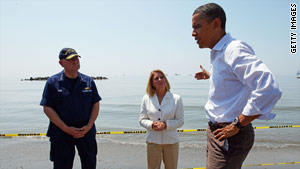
President Obama visits the Gulf Coast to assess the damage up close.

  President Obama visits the Gulf Coast to assess the damage up close.

  STORY HIGHLIGHTS

  Obama should set up a daily command center in Washington

  Have two deputies, one directs leak-stoppage; one directs clean-up

  Summon all the major oil and drilling companies for emergency efforts to plug hole

  If BP needs new internal leadership, figure out how to get that done

  Enough is enough! After the latest failure by BP to plug the gaping hole, it is time for President Obama to take full command of this growing national catastrophe. Immediately!

  The president in his press conference this past Thursday assured the nation that he and his administration were already in charge and he has manfully taken personal responsibility -- "the buck stops here," he said, echoing Harry Truman. Well, it may be true that BP has been acting all along under the oversight of the federal government, but that supervision has been loose and ineffective.

  To the world, it has been apparent that the government has been riding shotgun and BP has been at the wheel. It's time for the White House to get in the driver's seat and get us to safety -- fast.

  First off, who can now trust BP to do the job right? From the beginning, it has appeared to be more interested in shoring up its stock price than in playing straight and solving the problem. It took reckless short cuts in opening up the rig, had no serious plan in place for a disaster, low-balled early estimates of the spill, has high-balled its chances of stopping the leak and has kept both the government and the public too much in the dark. And its efforts on shore are increasingly pathetic -- can it really have failed to protect the safety of beach workers and have stage managed the clean-up when Obama was there, as reported? It was a mistake to leave our fate in the hands of this company as long as we have.

  Second, even if BP were reliable, the problem has clearly become too big for it to handle, as Colin Powell is now arguing on television. We have been told for days that the top kill procedure was BP's best hope for stopping the leak and if that failed, we would likely have to wait until BP drilled new wells which might be as late as August. We can't wait that long. BP is especially not up to the task of protecting our precious shorelines and cleaning up the beaches. For that, we need the organizational strength of the U.S. military.

  Third, this catastrophe is increasingly threatening the nation's welfare. With a potentially dangerous storm season just around the corner, a continuing gush of oil will not only pose huge, long-term damage to the Gulf region but could easily wash the oil around the tip of Florida and up the East Coast. The loss to livelihoods, the economy and to ways of life would be immeasurable. It would be worse than Katrina and Exxon Valdez put together. Unless we solve this soon, this spill could do to off-shore drilling what Three Mile Island did to nuclear power -- darn near kill it. Obama is right that it is a wake-up call to end our addiction to oil, but we need some forms of off-shore oil as a bridge to that future.

  Finally, Obama's leadership is increasingly at stake in this emergency. I thought Peggy Noonan was premature in arguing in the Wall Street Journal this weekend that the spill has already broken his presidency, but her column certainly gave pause. The cameras down at the bottom of the sea give us vivid reminders that this oil is spewing forth day after day after day -- almost like the daily television reminders we had of how long our hostages were held in Teheran while Jimmy Carter sat helplessly in the White House, the authority leaking out of his presidency.

  What can the White House do? For starters:

  -- Set up a daily command center in Washington where a presidentially appointed leader runs the show, calls the shots, coordinates the overall effort, briefs the president and briefs the country

  -- Have two deputies, one to direct the leak-stoppage and the other to direct the clean-up. Ex-CEOs and generals would be excellent candidates

  -- Summon all the major oil and drilling companies to the White House for emergency efforts to get the hole plugged

  -- Get BP out of the picture for clean-up; just send it the bill. If it is still needed for hole-plugging, okay, but ensure that it answers every day to directions from the government. If BP needs new internal leadership, figure out how to get that done

  -- Employ the U.S. military for organizational coordination and where needed, for anything else such as clean-up

  -- Make more aggressive efforts to tap the best minds in the world for help

  -- Provide the country with the kind of daily briefings that the military has mastered for wartime -- bring in people who are smart, straight and tough

  -- Ensure that economic assistance is provided to families, small businesses and communities that need it with dispatch and generosity

  -- Call off the finger pointing until we get out of this mess

  -- And finally, very importantly, exercise the powers of leadership every day from the Oval Office

  The whole country now has a keen interest in the White House now taking full command. Mr. President, it's your move. The nation cannot afford to wait that long -- the government needs to summon all the big oil and drilling companies to the White House on an emergency basis and seek faster answers.


A New Pragmatism Behind the Catwalk


  Ian Gavan/Getty Images for Burberry

  Christopher Bailey, at the Burberry show in London in February, holds the title “chief creative officer” to reflect his many roles.

  PARIS — A postrecession strategy likely to define luxury brand management for the early 21st century has emerged from a week packed with designer changes at European fashion houses.


  Francois Durand/Getty Images

  The designer Marc Jacobs of Louis Vuitton.


  David Burton, via Associated Press

  Sarah Burton was promoted to creative director at Alexander McQueen.


  Tullio M. Puglia/Getty Images

  Giles Deacon recently was given the title of creative director at Emanuel Ungaro.

  And the message is as clear as the Champagne glasses that are being brought out now that sales figures and profits are rising again: the era of the star designer picked to create buzz and shake up the system in a venerable house is over.

  As brand managers struggle to wrest control in the world of online sales and blog, Twitter and Facebook commentaries, designer creativity is still cherished. But extravagance in style or financial largess is out of fashion.

  Today’s role model is not Karl Lagerfeld, appointed designer at Chanel in 1983. Nor is it John Galliano, who has been shaking up Dior since 1996. It is rather the multitasking Christopher Bailey at Burberry, who last year was given the title of “chief creative officer” to encompass his overall role as merchandiser, brand manager, information technology innovator, advertising inspiration and e-commerce controller — all alongside his main day job as design director.

  Burberry announced this week a net profit of £81 million, or $118 million, in contrast to a loss of £6 million in the previous financial year, and a 6.6 percent growth in sales to £1.8 billion. But perhaps the more significant figure that the chief executive, Angela Ahrendts, produced was the rise in accessories to 36 percent of overall sales, making not the famous Burberry trench coat but other ancillary products the best sellers.

  The rise of interseason sales and of product diversity is putting into question the role of the designer superstar taking a bow at the end of a twice-yearly catwalk fashion show. Instead, the luxury industry wants to turn down the volume on big names, use a designer as global ambassador and focus on overall brand development.

  Significantly, in two recent appointments — of Frida Giannini at Gucci and of the design duo at Valentino — the designers were plucked from the accessory creative teams, not from among graduates of the Central Saint Martins fashion and design school.

  Hermès announced on Wednesday the departure of Jean Paul Gaultier after seven years as creative director of the women’s line. The madcap-turned-classic French designer will concentrate on his own label, in which Hermès holds a 45 percent stake. He is being succeeded by Christophe Lemaire, the low-key designer of Lacoste, famous for its crocodile logo on streamlined sportswear, rather than for rarefied haute luxury.

  At Alexander McQueen, bereft since the suicide of the designer in February, the parent company Gucci Group announced his successor as Sarah Burton, his loyal deputy since 1996. She also is the woman who turned Mr. McQueen’s hyper-inspiration into sales-floor reality. The blogosphere had proposed Gareth Pugh, a feisty young British designer, as Mr. McQueen’s successor, but the signal from the Gucci management was quite different.

  Even when Ungaro picked the British designer Giles Deacon on Tuesday, the choice was for a safe pair of hands.

  Since its founder announced his retirement in 2005, the Paris house has had a revolving door of designers, culminating in disastrous debut last season of the young Hollywood celebrity Lindsay Lohan. By contrast, Mr. Deacon is a 40-year-old designer with a couture sensibility who has developed his own house and could make a serious job of resuscitating the Emanuel Ungaro heritage.

  At Louis Vuitton, where a decade of the designer Marc Jacobs was celebrated this week with a small retrospective display of clothes at the new Louis Vuitton megastore in London, the message was also clear.

  Mr. Jacobs plays a crucial creative role, yet the main floor of this 16,000-square-foot, Bond Street emporium does not contain a single garment. Instead it is dedicated to the upscale accessories from the famous LV bags through its travel trunks, fine and costume jewelry or scarves to luxurious gifts like picnic hampers and poker sets.

  Vuitton of France was in the news for a less desirable reason: a ruling by the British Advertising Standards Authority that its images, resembling Dutch Old Masters with a soft-focus seamstress plying needle and thread, were “misleading” in claiming that “infinite patience protects each overstitch.”

  In fact, the bags are almost entirely factory-made.

  That is the story of today’s luxury brands: money-making machines in which a strong designer, leading a team, is crucial for the initial inspiration, originality and imagination. But the creative force is now found in a wired office — not in an ivory tower.

Tom Ford


  Tom Ford, the former creative director of Gucci and Yves Saint Laurent, turned louche sexuality into high fashion in the 1990s.

  In that decade, Mr. Ford was arguably the most influential fashion designer of his generation, re-imagining 1970s chic with unsubtle sex appeal. Under his guidance, the houses of Gucci and, later, Yves Saint Laurent flourished, with Mr. Ford overseeing every creative aspect — fashion, advertising, even store design — and making the labels a can't-live-without. At Gucci, he was a superstar, designing 16 collections a year. Among his most riveting creations were the velvet hip-huggers he introduced in 1994 and the Opium perfume ad from 2001 featuring a writhing, naked Sophie Dahl.

  But after a rancorous spat with his bosses, he left Gucci in 2004 and joined the ranks of the once powerful, temporarily unemployed. He announced that he would become an auteur. His movie directorial debut is "A Single Man," opening in December 2009. It has won plaudits from critics, particularly for Colin Firth's sensitive portrayal of George, a 1960s gay professor who contemplates suicide after his longtime partner dies in an accident. Mr. Ford financed the nearly $7 million project with his own money.

  He bought the rights to "A Single Man," the 1964 novel written by Christopher Isherwood, in 2006. The rights came with a script by David Scearce, which Mr. Ford decided to rewrite. To prepare, he read books, including "On Directing Film" by David Mamet. He showed an early draft to a studio executive, who told him to hire a professional. He tried collaborating with a screenwriter but they disagreed. In all, Mr. Ford said he revised the script 15 times in less than two years.

  The serious story — suicide, death, tragic romance — was a departure from the Tom Ford of Gucci who liked to provoke. (In one of his more controversial Gucci ads, a woman tugs at her panties to reveal a patch of hair shaped like a "G.")

  Read More...

  The subject matter, too, made it difficult for Mr. Ford to get a studio to finance his film. His friends told him to create a short film to show what he could do. Mr. Ford said he had a verbal agreement with two investors but the deal fell through after the stock market tumbled.

  His agents, he said, told him not to pay for film production himself. But Mr. Ford made a lot of money at Gucci and decided to do so anyway. Besides, it afforded something he covets most: complete creative control.

  During his decade as the creative director of Gucci, Mr. Ford took the Italian house from a moribund label making $230 million a year to a $3 billion powerhouse. Gucci was a leather-goods house when Mr. Ford arrived in 1990 — and practically a bankrupt one. But he gave Gucci fashion, and then he gave the fashion, through his marketing and advertising skills, meaning.

  What Tom Ford did for fashion, more than anything else, was to add sex to the equation. He created an identity for Gucci — the jet set, vaguely 70s superbabe (or guy) who traversed the globe in high style. The Gucci woman was sleek and fiery, and the Gucci man was, well, Tom Ford. More than any designer since Coco Chanel, he was his brand.

  He remade Gucci in his image: the stores were decorated in the same midcentury style as his homes, and the clothes were designed to fit into that tableau. A teen actor, he has always had a strong sense of presentation. ''I am a perfectionist,'' Ford said in 1996, before his third and perhaps most important women's collection, the one that cemented his reputation. ''This job is a total ego thing in a way. To be a designer and say, 'This is the way they should dress; this is the way their homes should look; this is the way the world should be.' But then, that's the goal: world domination through style.''

  Ford has always taken concepts and images that he loved and reinvented them as clothes or bags or shoes that inspired a similar connection in consumers. He was the first designer to envision the world as a global marketplace that could be linked by a sensibility — his sensibility. He and Domenico De Sole, Gucci Group's chairman and chief executive, made Gucci the first real high-end global fashion brand.

  When PPR, headed by François-Henri Pinault, the son of one of France's wealthiest men, bought Gucci, it entrusted Ford to expand the company. In 1999, the company purchased Yves Saint Laurent. Ford had success at YSL. As at Gucci, he endeavored to create signature pieces: the Mombasa bag, with its horn handle, echoed the Gucci bamboo bag, and in 2001, his purple peasant blouse for YSL created a sensation.

  After he left Gucci, he wrote a book about his years there. In 2005, Mr. Ford designed two makeup collections for Estée Lauder in which he updated the brand's classic iconography and reincarnated a signature perfume Youth Dew as Amber Nude.

  John Demsey, group president of Estée Lauder Companies, said that Azurée, one of the two makeup collections, was the largest selling collection in the brand's history.

  In 2006, Mr. Ford developed the first fragrance with his name behind it — Black Orchid. It was made from a recherché dark orchid. The ad campaign featured Julia Restoin-Roitfeld, the daughter of the editrix of French Vogue, in an old-style Hollywood glamour shot, all red lipstick, dreamy hair and bedroom eyes.

  In 2007, he opened his first store, on Madison Avenue in New York. It was staffed with uniformed butlers and maids and a receptionist at the front door. The merchandise, rather classic when compared with Mr. Ford's Gucci signatures, was displayed in glass cabinets. Women's Wear Daily described the concept as "uberluxury."