Tuesday, July 13, 2010

Bad news doesn't bring down Sox


A.J. Pierzynski

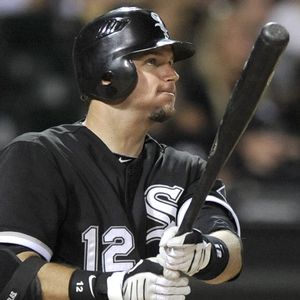
  AP Photo/Paul BeatySox catcher A.J. Pierzynski watches his three-run home run against the Royals in the eighth inning. For the second time this week, the White Sox simply brushed off potentially grim news as if they were swiping a gnat from their ever broadening shoulders.

  With games like the Mark Buehrle- and A.J. Pierzynski-inspired 8-2 victory over the pesky Kansas City Royals, the White Sox just keep getting stronger. They have now won six consecutive games, 19 of their last 23, and 23 of their last 28.

  When Jake Peavy went down with a serious injury Tuesday, the White Sox kept on winning. The most recent solid play came Friday shortly after a double-dose of information that could have left them reeling once again.

  At about the same time Friday afternoon that Peavy confirmed that he would be lost for the year, the clubhouse television offered the news about Cliff Lee’s trade to the playoff-contending Texas Rangers.

  Nobody was in mourning, including an upbeat Peavy, who said he will remain with the team for the remainder of the season while he recovers from surgery next week.

  Even without Peavy, the White Sox aren’t afraid of Lee. In fact, bring him on, they say. “If we face Lee this season, that will be a good thing,” pitching coach Don Cooper said.

  His point is that the White Sox don’t have any regular-season games remaining with the Rangers so the only way they could meet would be in the playoffs. Cooper’s staff will gladly take its chances at that point.

  More good news from the Lee deal is that the Rangers still have seven games remaining with the third-place Minnesota Twins and five more against the first-place Detroit Tigers. The White Sox’ victory Friday kept them a half game behind the Tigers and put them three ahead of the Twins.

  “With that lineup they have, they’re very dangerous,” Sox manager Ozzie Guillen said of the Rangers. “I think that’s going to help those guys and put them over the top in that division. I was glad because off the top, I thought it was New York and Minnesota [who would land Lee], and we still have to play against them. So I’m glad Texas got him.”

  Nobody is as dangerous as the White Sox these days and pitching has been a big reason why. Since June 9, the White Sox are a baseball-best 23-5, posting a 2.38 ERA (66 earned runs/250 innings) over that stretch.

  While John Danks’ two-hit shutout Thursday came against a struggling Angels offense, the eight innings of zeroes posted by Buehrle and Sergio Santos were against a Royals team that entered with the best team batting average in baseball at .283. The Royals also entered batting .313 with runners in scoring position over their last 13 games, going 10-3 over that span.

  When Yuniesky Betancourt hit a two-run home run in the ninth inning off Jeff Marquez, it snapped the White Sox’s 17-inning scoreless streak.

  Target practice

  Six pitches into Friday’s game, the White Sox received a scare when Buehrle took a line drive from the Royals’ Scott Podsednik off his right wrist.

  Buehrle said he was in serious pain for about a half inning with some of his fingers even going numb at one point.

  He even yelled at his former teammate, but not because of the comebacker. He told Podsednik to steal second base already so he wouldn’t have to throw over to first base so much.

  “It got me pretty good, but they didn’t even take X-rays after they looked at it,” Buehrle said. “It feels totally fine.”

  He went on to beat the Royals for the first time in three tries this season and the 21st time in his career, second most to his 24 victories over the Twins.

  Double dose

  For just the third time in his career, Pierzynski hit two home runs in a game as he emerged from a dry spell with a vengeance. Pierzynski had just one hit in his last 17 at-bats before Friday’s game when he hit a solo shot against Bruce Chen in the fourth inning and three-run homer against Victor Marte in the eighth.

  “A.J has been struggling for the last couple of weeks,” Guillen said. “Now he’s starting to swing the bat better.”

  Quote of the day

  “I kind of thought about [400], but I think it was a changeup and I top-spinned it a little more rather than hitting through it,” -- Andruw Jones, on his fly ball to deep left field in the eighth inning that kept him at 399 career home runs. He ended up tying a season-high with three hits after entering with two hits in his previous 23 at-bats.

  Looking ahead

  Red-hot Gavin Floyd (4-7, 4.43 ERA) has been as good as anybody over his last six starts, going 2-1 with an American League-best 1.27 ERA over that stretch. He also has 37 strikeouts during that run. He is just 1-2 with a 6.16 ERA against the Royals, who he will face at home Saturday. He will be opposed by the Royals’ Brian Bannister

Monday, July 12, 2010

World Cup post-game: Spain 1, Paraguay 0


Spain's David Villa, left, celebrates with teammate Cesc Fabregas after he scores his side's only goal during their quarter-final against Paraguay in Johannesburg.

  Spain's David Villa, left, celebrates with teammate Cesc Fabregas after he scores his side's only goal during their quarter-final against Paraguay in Johannesburg. (Jasper Juinen/Getty Images)

  David Villa scored in the 83rd minute to lift Spain to its first-ever FIFA World Cup semifinal appearance after dispatching Paraguay 1-0 Saturday in Johannesburg.

  To watch the match highlights, CLICK HERE. To watch the full game, CLICK HERE.

  Main storyline

  For a game with everything on the line, it was a dreary affair for much of the match.

  Paraguay manager Gerardo Martino elected to make six changes to his starting 11 for this game, benching his three scoreless strikers (Roque Santa Cruz, Edgar Benitez and Lucas Barrios) and switching from his usual 4-3-3 formation to a more defensive 4-4-2 system in an attempt to stop the talented Spaniards.

  The tactic worked for much of the game. Paraguay clogged their defensive third, containing Spain's skilled players like Xavi, Andres Iniesta and Xabi Alonso, giving them very little time on the ball to create scoring chances.

  Spain finally broke through in the latter stages of the match, with Villa burying his fifth goal of the tournament to secure the victory.

  Of course, the outcome could have been much different had Nelson Valdez's goal counted in the 41st minute (he was ruled offside). With the defensive game plan Martino's squad was employing, a one-goal lead might have held up.

  For Spain, the quarter-final win was a positive step in shedding its label as "chokers" on the world stage. Though it's ranked No. 2 in the world, is the reigning European champion and has only lost three of its last 55 games, Spain still has that stigma of not winning soccer's biggest prize.

  To get a chance at that elusive crown, it will have to get through Germany, the same team Spain defeated 1-0 to capture Euro 2008.

  What this result means

  Spain advances to the semifinals next Wednesday where it will meet Germany, 4-0 winners over Argentina in the other quarter-final earlier Saturday.

  It's the first time La Roja have reached the semifinals of the World Cup (they finished fourth in 1950, when the title was decided by a four-team final).

  The turning point

  It was an uninspiring fixture until the 57th minute when, within a span of two minutes, both teams were awarded penalty shots.

  First, on a Paraguayan corner kick, Spain defender Gerard Pique was yellow-carded for yanking down Oscar Cardozo with both hands. On the ensuing penalty kick by Cardozo, goalkeeper Iker Casillas dove the right way and made the save.

  Just a minute later in the other end, Paraguayan fullback Antolin Alcaraz banged into David Villa in the penalty area and a spot kick was awarded. Xabi Alonso stepped up and clinically finished the penalty, but the referee ordered a re-kick because Spain's players entered the box before the ball was kicked.

  On the re-do, Paraguay keeper Justo Villa stopped Alonso's strike, keeping the game locked 0-0.

  From then on, the pace of the match picked up.

  The winning goal

  Iniesta worked his magic just outside the 18-yard box, dribbling through two Paraguayan defenders before passing the ball off with the outside of his foot to Pedro streaking down the right side. Pedro's strike rang off the right post, but Villa was there to gobble up the rebound, cracking a shot that went off both posts and in for his tournament-leading fifth goal of the World Cup.

  Man of the match

  Spain goalkeeper Casillas wasn't very busy in this match, but he came up big when he was called upon. In the 57th minute, he stopped a penalty shot by Oscar Cardozo and in the final minute of the game, he preserved the win for his team, stopping Roque Santa Cruz's point-blank shot.

Monday, July 5, 2010

  Can Poland's new president deliver political stability?


Bronislaw Komorowski at his election headquarters in Warsaw - 4 July 2010

  Mr Komorowski is expected to work closely with the government Bronislaw Komorowski's election as Polish president sets up a rare period of calm and cohesiveness on the country's political scene and will be welcomed in Berlin and Brussels.

  In the tightest presidential contest in 15 years the results swung back and forth overnight between Mr Komorowski and his rival, Jaroslaw Kaczynski, the identical twin of the late president, Lech, who was killed in a plane crash in Russia in April.

  Mr Komorowski, 58, who has aristocratic roots and was interned for his opposition activities by the communist authorities in the 1980s, is widely regarded as a moderate.

  He represents stability because he is the candidate of the governing Civic Platform Party.

  He is expected to work closely with the government on its programme of free market reforms and closer engagement with the country's European Union partners and Russia.

  In Poland the presidency is a largely ceremonial role, but the president can block legislation through the power of veto, something Lech Kaczynski used regularly.

  "This will be a more stable, predictable cohesive period for the country, one we have never had before," Pawel Swieboda, head of the demosEUROPA think-tank, told the BBC.

  "He will be a supportive president with the government in the driver's seat and he being more of a helping hand. He will focus on representative functions, social dialogue and discussing future challenges," he said.

  Without the presidential veto as an excuse the government will now be under pressure to present a clear plan to tackle the budget deficit, structural reforms and reduce bureaucracy in business.

  "It will force Civic Platform to come out with its own set of ideas. They will have no excuses and will have to start acting.

  "It will be a very different period to anything we've seen so far and an opportunity for long-term planning," Mr Swieboda said.

  However, with parliamentary elections looming in just over a year, Poland's cautious Prime Minister, Donald Tusk, may be reluctant to damage his government's chances of being re-elected, something no other administration has achieved since communism ended in 1989.

  Attitude change

  Those elections will feature the 61-year-old Jaroslaw Kaczynski.

  He may not be president but his remarkable result provides a platform for his socially conservative and state interventionist opposition Law and Justice Party to challenge for power.

  Bearing in mind that Poles voted Mr Kaczynski, a combative former prime minister out of office three years ago, his result crowned a superbly-fought campaign.

  "I think he ran a smart campaign. He has moved to the centre ground and combined newly-found moderate views with assertiveness which appeals to people," Mr Swieboda said.

  When you offer a twist of social inclusiveness in domestic policy, it's an appealing message," he added.


Jaroslaw Kaczynski watches results come in

  Jaroslaw Kaczynski revitalised his image in the election campaign Mr Kaczynski was also helped by the sympathy Poles felt for the families of the victims of April's plane crash.

  Before the tragedy, Jaroslaw Kaczynski was regularly voted one of the country's least-trusted politicians.

  His divisive and antagonistic stance as prime minister, during which he seemed bent on leading what some described as a witch-hunt against former communist officials, was still fresh in people's memories.

  Mr Kaczynski's political views are shaped largely by his belief that the communists merely swapped political power for economic influence during the negotiated transition to democracy.

  During the campaign he dropped the anti-communist slogans and even called the former party chief, Edward Gierek, a patriot.

  He also changed his attitude towards Poland's neighbours and old foes, Russia and Germany.

  Together with his brother, he once irritated German officials with a proposal that the EU take into account Poland's six million World War II victims when allocating voting rights.

  During the campaign he made positive noises about Germany and recorded a moving broadcast to Russians for their help in assisting the families of the plane crash.

  His repeated insistence, however, that Poland take over the crash investigation did imply criticism of Russia's handling of the affair.

  He has clearly benefited from his more moderate approach and will probably not want to be seen as being a largely destructive force in the run-up to next year's ballot.

  The other winner from these elections has been the former communists, now re-branded as social democrats.

  Voted out of office five years ago following numerous sleaze scandals, the left-wing's young personable leader, Grzegorz Napieralski, won a reasonable third place in the first round, signalling a return to influence.